
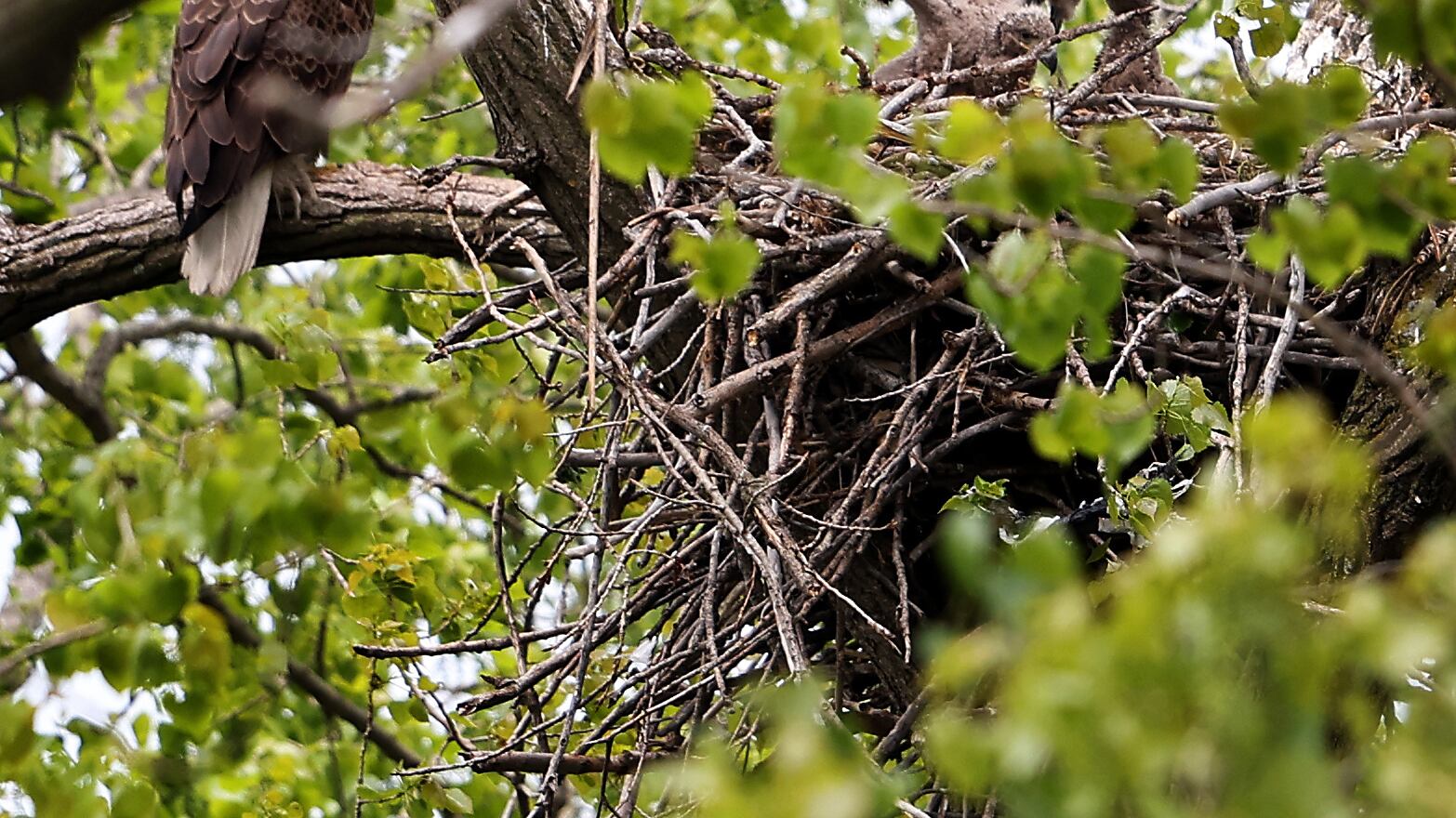
CHICAGO — Two bald eagles hatchlings have been spotted in a nest in a Chicago park in what city officials believe is the raptors' first successful wild breeding in the Windy City in more than a century.
Chicago Park District officials announced last week that bird-watchers observed nesting activity starting in February in Park 597 along the Calumet River on the city's Southeast Side. The first eaglet was spotted in the nest on April 28 and a second was confirmed May 7.
Irene Tostado, a park district spokesperson, said the eaglets appear to be two to three weeks old.
Pat Pearson and her husband, Steve, discovered the first eaglet.
“We started looking around, and lo and behold, this little fuzzy head sticks up with a big beak and we were just ecstatic. Patty actually broke into tears. I started crying," Steve Pearson said. "It was really very touching, because we had this kind of instinct, I think, just the wonder and the awe of seeing these eagles right here in Chicago with a baby. It was really overwhelming.”
Habitat degradation and insecticide contamination of food sources decimated the bald eagle population in the second half of the 20th century, but the bird has made a dramatic comeback over the last 40 years. The bald eagle — the official national bird of the United States — was removed from the federal endangered species list in 2007.
They're not an uncommon sight in the Chicago area. The park district said it counted a dozen bald eagles in the restored wetlands of Big Marsh Park in one day in 2018. But Stephen Bell, who oversees Park 597, said his staff hasn't found any record of a successful eaglet hatching in Chicago for more than 100 years.
Park 597 was home to a city water treatment plant until the park district took over the property in 2019 and started restoring the natural habitat. Bell said soil improvements, upgraded vegetation and enhanced habitat for amphibians and reptiles have attracted muskrats, mice and deer, as well as eagles.
“Give Mother Nature a chance and you'd be surprised what she can do with just a little bit of help from like the park district and the city of Chicago," Pat Pearson said. “Neither one of the organizations could have done it themselves, but between the two of them, it's shocking what can happen to land in areas that you think are just absolutely unredeemable.”
___
Richmond reported from Madison, Wisconsin. Associated Press photographer Erin Hooley contributed.
Copyright 2026 The Associated Press. All rights reserved. This material may not be published, broadcast, rewritten or redistributed without permission.