


Half of homeowners now call the American Dream ‘eroding’ or ‘broken,’ survey finds
Homeownership has long carried a certain weight in the United States. It has been described as a foundation for stability, a path to wealth, a rite of passage, and — most durably — a cornerstone of the American Dream. As the country marked its 250th birthday in the summer of 2026, one survey set out to learn how homeowners themselves view the experience today.
The survey, conducted by Hometap in June 2026, asked 1,000 U.S. homeowners about the moment of purchase, the experience of ownership over time, what the 250-year milestone represents, and what it all means for the next generation. The findings describe a population that still believes in homeownership as an idea but is increasingly skeptical that the system delivers on it.
Here is what the data revealed across eight key findings.
The meaning of homeownership has shifted, but stability still anchors it
When asked what single word best described homeownership to their parents’ generation, 56% of respondents said "stability." Asked what it means to them today, 51% still chose that word — so the core meaning has not shifted dramatically. The larger changes appear elsewhere: "investment" rose from 19% to 27%, and "burden" more than doubled, from 3% to 6%. Homeownership is still seen as a foundation, but increasingly with mixed feelings.

Hometap
Most homeowners say the dream hasn't fully delivered
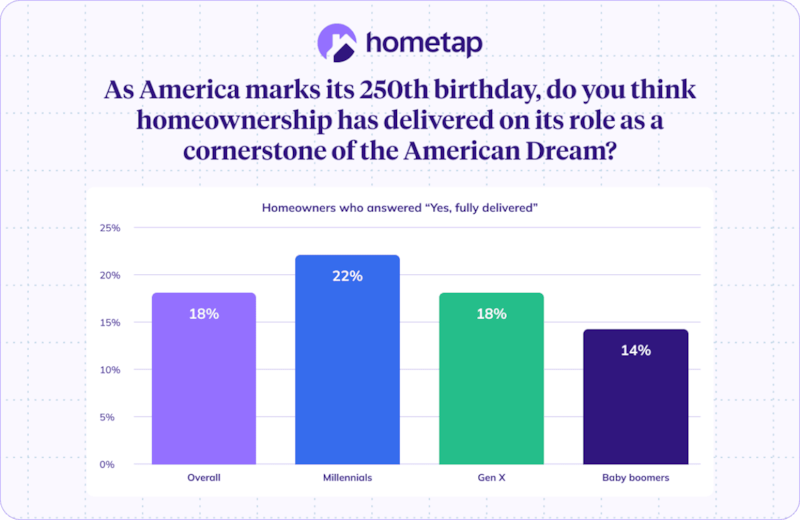
Just 18% of homeowners say homeownership has fully delivered on its role as a cornerstone of the American Dream. Another 45% say it has partially delivered and a combined 36% say it has largely or completely fallen short. That sentiment holds across every generation and region surveyed. Baby boomers stand out: the generation that benefited most from homeownership on paper had the fewest respondents saying it fully delivered (14%) and the largest share saying it only partially delivered (55%).
Hometap
Half of homeowners describe the dream with a negative word
"Evolving" leads overall at 32%, but "eroding" (27%) and "broken" (24%) combined account for 50% of responses. The generational split is notable. Baby boomers are the only generation whose top answer is "eroding," at 38% — nearly double the percentage of that group who said "enduring" (21%). Millennials are the most likely to say "broken," at 26%. The distinction is meaningful: Baby boomers watched something decline, while millennials feel they inherited something that already does not work. The same conclusion arrives from different starting points.
Most homeowners still feel owning a home was worth it, but pride is uneven across generations
Nearly half of homeowners (49%) describe owning their home as a major achievement, and 66% lean positive overall. Still, 11% describe it as an obligation or more of an obligation than an achievement. Baby boomers are the most likely to call it a major achievement (54%), and millennials the least (47%).

Hometap
Homeownership brings opportunity, but the benefit isn't evenly felt
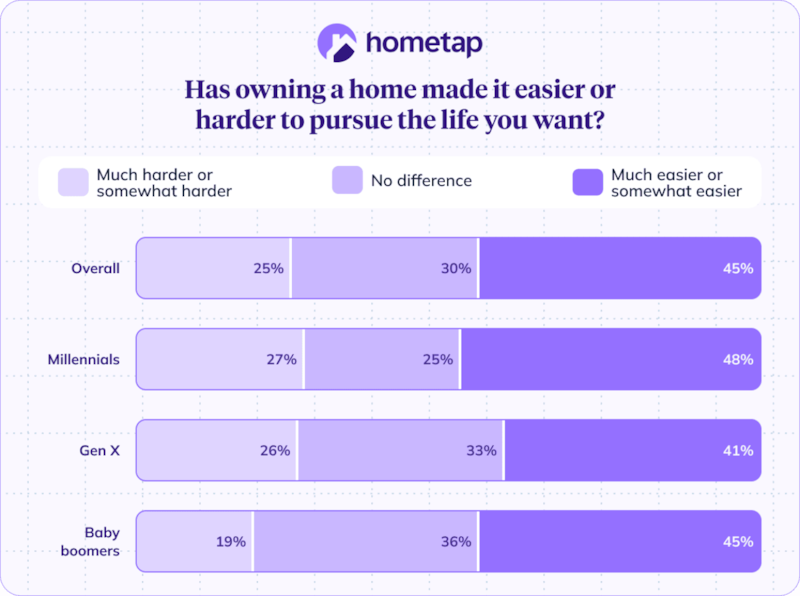
About 45% of homeowners say owning made it easier to pursue the life they wanted. But 30% say it made no real difference, and 25% say it made life harder. Millennials show the widest range — the most likely to say "much easier" (19%) and also the most likely to say "much harder" (10%) — suggesting that for younger owners, homeownership tends to work well or not at all, with less middle ground.
Hometap
Baby boomers are more pessimistic about homeownership than expected
The generation widely believed to have benefited most from homeownership gives it the harshest appraisal as an institution. Baby boomers are the only generation whose top descriptor for the dream is "eroding," and they are the least likely to say it fully delivered. They are also the most worried they will need their retirement savings for their own retirement before they can help their children become homeowners, with 63% agreeing or strongly agreeing, compared with 51% of millennials. While their personal experience was largely positive, their view of the system is not.
Parental support is now seen as a requirement, and most parents can't provide it
Sixty-one percent of homeowners agree or strongly agree that the homeownership wealth gap is now so large that parental help is becoming a requirement rather than a bonus. That figure is nearly identical across generations: 62% of millennials, 63% of Gen X, and 63% of baby boomers. Yet only 40% say they have enough resources to help, while 60% do not. The consensus that there’s a problem is near-universal, but most can’t clear the bar.

Hometap
Home equity is an obvious solution, but almost no one is using it
Only 9% of homeowners say tapping their home equity is their most realistic path to helping their children buy a home. The most common answer remains leaving the home as an inheritance (27%), deferring the transfer of their wealth until death rather than accessing it when it could make a difference. And 59% of homeowners say they have never thought of their home equity as a tool to help their family buy a home — a figure that rises to 69% among baby boomers, the group with the most accumulated equity. The asset is there; the awareness of it as a tool is not.

Hometap
What homeowners are telling us about the dream in 2026
Across generations, the data tells a consistent story. Homeowners still believe in homeownership as a concept, and they still experience it, more often than not, as a positive in their lives. But they are increasingly skeptical that the system is working — not only for themselves, but for the people who will inherit it.
The aspiration is durable even as the institution strains. The dream does not die with one generation's skepticism; it gets passed forward, reshaped by what each generation was told, what they experienced, and what they believe is still possible for those who come next.
Methodology: The survey was conducted by AYTM on behalf of Hometap from June 21-22, 2026, among 1,000 homeowners in the U.S. ages 18 and over, representing a mix of ages, demographics, and regions. Respondents were recruited through AYTM's online panel and screened to confirm that they own a home. The 14 question survey measured perceptions and sentiments around owning a home and was administered online with randomized multiple-choice options. Figures have been rounded up to the nearest whole number in this article. Results reflect a 95% confidence level with an approximate 3% margin of error.
Generations were grouped as follows: millennials ages 25-44, Generation X ages 45-64, and baby boomers ages 65-79.
This story was produced by Hometap and reviewed and distributed by Stacker.